Design Thinking


According to Tim Brown (2010), design thinking takes advantage of a capacity every human being has, one that conventional problem-solving practices ignore. So design thinking proposes not only a people-centered view, since it is naturally human, but an approach based on intuition, pattern recognition, and the development of ideas with emotional meaning beyond the functional, and expression through media rather than words. In other words, an integrated approach that proposes a "third way."
The term Design Thinking came out of a conversation between Brown and David Kelley, a Stanford professor and founder of IDEO. Kelley noticed that when someone asked him about design, he found himself including the word "thinking", to explain the skills of designers. That is how the term Design Thinking emerged (BROWN, 2010).

According to Viana et al. (2012), Design Thinking is associated with the way designers think, seeking solutions to many kinds of problems through unconventional thinking. This thinking shows up as questions raised by research and observation of the problem's context.
The Design Thinking can be understood as an approach focused on people, multidisciplinarity, collaboration, and the development of processes and ways of thinking aimed at generating innovation.
For Phillips (2008), design is a problem-solving discipline, and when the problem's context sits within a business environment, design must solve those problems. For the author, the designer is responsible for proposing solutions and understanding the role of design in business: asking which problems a given company may be facing, what keeps its managers up at night, and what the main obstacles are, and then reflecting on how design can help solve these issues.
Design Thinking emerged as an agile means to innovate and improve organizational performance, enabling designers to propose solutions to people's needs and improvements to their experiences when using a product or service (SERRAT, 2010).
According to Viana et al. (2012), Design Thinking is a relevant approach to innovation, because design added a complement to the market's view, in which innovation focuses on new technologies or other markets. This approach innovates by introducing new meanings to products or services.
Viana et al. (2012) propose certain stages which, although presented linearly, have flexibility, making it possible to shape plans according to the nature of the project.
Diagram of the stages of the Design Thinking process.
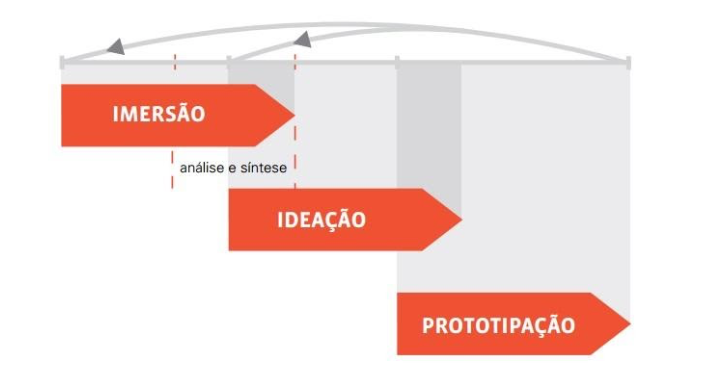
"The first phase of the Design Thinking process is called Immersion. At this stage, the project team gets close to the context of the problem, both from the company's point of view (the client) and from the end user's point of view (the client's client)" (VIANA et al. 2012, p. 21).
According to Viana et al. (2012, p. 22), "Immersion can be divided into two stages: Preliminary and In-depth. The Preliminary stage includes Reframing, Exploratory Research, and Desk Research.
The reframing process concerns the strategic alignment between the project team and the client company. Exploratory Research can then be carried out in parallel with Reframing; it consists of understanding the context of the topic. Desk Research, in turn, surfaces trends on the topic locally and abroad, to help understand the subject. "Preliminary Immersion therefore aims to define the project's scope and boundaries, and to identify user profiles and other key actors who should be engaged" (VIANA et al. 2012, p. 22).
In-depth immersion is the stage for gathering the universe of actors and the topic at hand. The focus is usually on the human being, in order to collect four types of information: What do people say? How do they act? What do they think? How do they feel? The goal is to map extreme behaviors, patterns, and latent needs (VIANA et al. 2012).
The Ideation phase "aims to generate innovative ideas for the project's topic, using the synthesis tools created in the analysis phase to stimulate creativity and generate solutions that fit the context of the subject" (VIANA et al. 2012, p. 100).
The prototyping stage "helps validate the ideas generated and, although it is presented as one of the last phases of the Design Thinking process, it can happen throughout the project, in parallel with Immersion and Ideation" (VIANA et al. 2012, p. 122).
With this approach, the expectation is to use research tools and gain knowledge about developing innovative products and services, in order to reach disruptive solutions.
References
BROWN, Tim. Design thinking: uma metodologia poderosa para decretar o fim das velhas idéias. Rio de Janeiro: Elsevier, 2010.
PHILLIPS, Peter L. Briefing: a gestão do projeto de design / Peter L. Phillips. São Paulo: Blucher, 2008.
SERRAT, Oliver. Design Thinking: Knowledge Solutions, March, n. 3, 2010. Available at: <https://www.adb.org/sites/default/files/publication/27579/design-thinking.pdf>. Accessed: October 13, 2021.
VIANA, Maurício et al. Design Thinking: inovação em negócios. 1st ed. Rio de Janeiro: MJV Press, 2012. Available at: <http://livrodesignthinking.com.br/> Accessed: October 15, 2013.


Comments