Harness Design seriesArticle no. 01
Harness Design: the discipline that will redefine product design
Many companies with product design teams are trying to use artificial intelligence to speed up the work. And we know that, over the past few years, that work has increasingly become building interfaces for software: components, screens, flows, journeys. Experienced designers know design goes far beyond that, but that dense part, the visual construction, has become the biggest slice of the day to day.
Now AI is changing that picture structurally. And I want to talk about what we are living through in practice at Prolog, and about a term I believe will start to be part of the market’s vocabulary: Harness Design.
The metaphor that changed how I think
Everything got clearer when I read Why Your "AI-First" Strategy Is Probably Wrong, by Peter Pang. The central argument is simple and devastating: most companies are using AI as an auxiliary tool, when the right move is to put it at the center of production and redesign everything around that.
It is not about the designer using AI. It is about AI producing, while humans build the production line, feed that line with context, and review what gets generated.
That concept gained even more depth when Luiz Felipe (CTO at Prolog App) shared with the team the OpenAI article about Codex, Leveraging Codex in an agent-centered world, written by Ryan Lopopolo, which introduces the idea of the agent at the center, with humans orchestrating around it. It is not science fiction. It is the model we are trying to build right now.
From the Design System for humans to the Design System for machines
Today I see many design teams trying to optimize their design systems for tools like Figma Make or Lovable, still from the view of the designer building a prototype that a developer will later take to the final front-end. That is the conventional view, just with a new tool.
But what we are building now is different. We are no longer optimizing a library so that a designer can look, choose, and know where to use each component, or so that Figma Make can generate a bunch of ideas. We are creating an entire system designed so that a robot can consume it.
That means documenting with intent. It is not enough to name a button: you have to explain when to use it, in which context it makes sense, when it should not be used, and why. Every token, every variable, every component needs documentation robust enough for an LLM to make good decisions autonomously.
The article Your Next Design System User Is an AI Agent, by Kartva, which Glauber Franco brought to the team and which was, without exaggeration, gold for us, gave a much clearer map of how to make this transition in practice. It confirmed what we were already sensing and lit up points that were still murky about how to really optimize a Design System for LLMs.
What Harness Design is
Harness has two meanings that complement each other perfectly here.
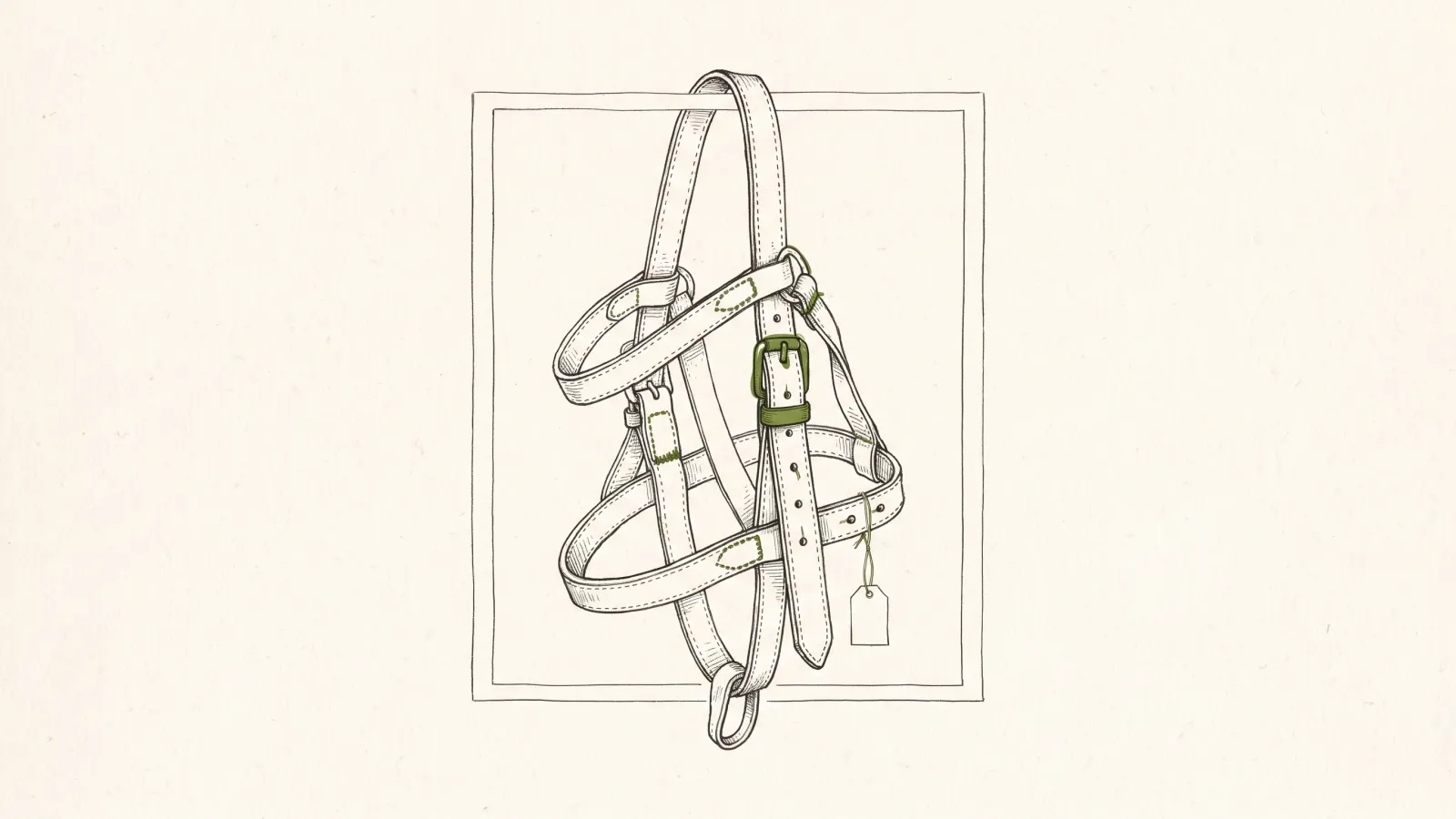
The first is harness as the gear: the structure that directs an animal’s strength without limiting it. A harness does not brake the horse; it channels its power to where you need to go. Without it, the AI gallops wherever it wants. With it, it goes where the product needs it.
The second is the verb to harness: to make use of, to channel. As in "harness the power of the wind": turning raw energy into something useful and controlled.
Harness Design, then, is the discipline of designing design systems documented with intent so that LLMs can make good autonomous interface decisions. It is the designer ceasing to be a builder of screens and becoming the architect of the context the AI will consume.
The designer’s new role: three positions, not one
In this model, the designer acts at three distinct moments, and all of them are critical.
Before: They define the intentions. They are the great librarian of the design system, creating the structure and the documentation that let the LLM make good decisions. Design is to designate, to give intent. And that is exactly the skill machines do not have. Every piece of software has its particularities, every business has its nuances. The designer needs to understand all of that and translate it into a language the machine can process. No longer looking only at form, the function of each element becomes central.
During: They lead the machine. Just as tech leads and managers removed blockers and secured resources for human teams, now all of us need to learn to do that for LLMs: ensure enough context, remove obstacles, provide what the AI needs to produce well. This layer already has a name in engineering, Harness Engineering. What I am proposing is that it exists in design too.
After: They review and curate. The designer remains the guardian of the customer experience. They look at what the AI produced and check whether it makes sense, whether it delivers real value, whether it is aligned with the needs of the business and the user, with everything that lives outside the documentation, in people’s heads.
And there is more: the designer can now build the front-end directly too. Using Claude Code or similar tools, they create functional interfaces and hand that front-end to a developer to refine, checking for security gaps and structural problems and making the connections to the back-end. The handoff stops being a Figma file full of ambiguities and becomes real code. The developer gets an even more technical and strategic role. Nobody loses their place: everyone changes position.
This is already happening on our team
I am not talking about theory. I am talking about what we are already building.
Gustavo Navarro is already creating production pipelines with multi-agents and skills in Claude Code, a practical demonstration that this model is not the future, it is the present. Glauber Franco is constantly bringing new knowledge about AI applied to design, and he was the one who brought the Kartva article that greatly accelerated our vision of Harness Design.
And this does not stay only in Design and Engineering. Together with Diogenes Vanzela, we are building a system with AI at the center for the upstream phases, problem definition and discovery, where PMs and designers work together. It is one of the most intriguing fronts we are pushing right now. And Hegon Damazo is already seeing concrete results from using skills and Claude to optimize PM work: discovery, documentation, planning, problem framing.
A lot is being born at the same time. And what impresses me is the speed at which people are learning and sharing.
Design as an industrial discipline: back to the origins
There is something very coherent in this transformation when we go back to the origins. Design has always been about creating artifacts that can be mass-produced: scalable systems, cheaper processes, a quality standard, faster delivery. Design System work is exactly that.
What changes is that the scale is no longer for other designers to use. It is for machines to produce.
Is there anxiety in all of this? Yes.
There is fear, there is FOMO, there is real uncertainty. LLM costs are still high and may rise further. There are AI companies that are still not profitable. Bubbles can form, and they can burst. But there is also courage to move forward, to learn from the experiments, and to understand how this new landscape can actually work.
The designer of the future will not disappear. They will become the architect of the intelligence that produces. And that, deep down, is a return to the roots of the discipline: deeply understanding the problem, defining the intent clearly, and making sure that what reaches the customer truly makes sense.
Harness Design is the name that, today, to me, describes what is already happening, and it will become more and more central for anyone who works in product.
Are you experimenting with something similar on your team? I really want to hear how other designers, engineers and PMs are navigating this change.
Attachments
Portuguese Medium: https://johnmorais.medium.com/harness-design-a-disciplina-que-vai-redefinir-o-design-de-produto-64fd9f5723bf?postPublishedType=repub
English Medium: https://medium.com/@johnmorais/harness-design-the-discipline-that-will-redefine-product-design-24ee80c0e38a
| Concept or Reference | Role in the AI Ecosystem | Definition or Application | | --- | --- | --- | | Harness Design | The discipline of designing design systems documented with intent for autonomous AI decisions. But not limited to that: it involves processes, tools, people, governance, everything for a team that needs to work AI First. | Channeling the power of AI through contexts and rules, turning the designer into a context architect. | | Your Next Design System User Is an AI Agent | Transition from the human-focused Design System to a model focused on AI agents. | A map for optimizing component libraries and variables (tokens) for consumption and interpretation by LLMs. | | Leveraging Codex in an agent-centered world | Introduces the model of the agent at the center of the operation with humans orchestrating around it. | Using Codex to create an environment where the machine executes the tasks and the human acts as the orchestrator. | | Multi-agent production pipelines | Automation of an integrated design and code production line through multiple agents. | Using skills in Claude Code to create workflows where AI agents collaborate with each other. | | AI in Upstream (Discovery) | Structural support in problem definition and in the product discovery phase. | A system with AI at the center to help PMs and designers in the phase of understanding and defining the initial strategy. | | Optimizing PM tasks with Claude | Use of artificial intelligence to automate product management. | Applying skills to optimize discovery, documentation, planning and problem framing. | | Why Your "AI-First" Strategy Is Probably Wrong | Places AI at the center of production instead of treating it only as an auxiliary tool. | Redesigning product strategy with AI as the main engine, where humans build the production line. | | Harness Engineering in Design | Role of technical leadership and removing blockers for the machine’s production. | Ensuring enough context and removing technical blockers so the LLM produces interfaces smoothly. |