Post
The power of humility
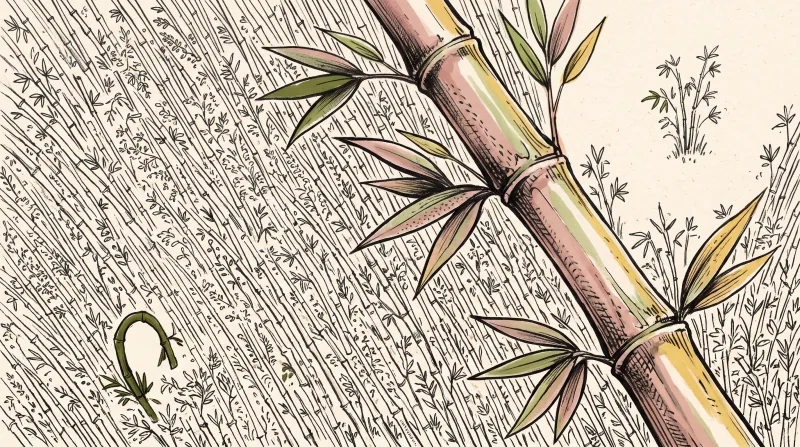
Bamboo is one of the symbols of humility, because it bends with the wind but stays whole.
According to the Oxford dictionary, humility means the quality of being humble, the virtue characterized by an awareness of one's own limitations; modesty; simplicity.
It can also mean a feeling of weakness, of inferiority, reverence or respect toward superiors, lack of luxury or a condition of economic disadvantage.
I will approach humility in the sense of the virtue, as a condition that can seem invisible, inferior, but that turns out to be powerful.
Before going deeper, it is worth noting that everything exists in kind and degree. That is, humility is a kind that has infinite degrees, so we are all humble to some degree, whether negatively, neutrally or positively, and these degrees also vary according to the moment of our lives.
Imagine a circular thermometer with infinite variations of degree, zero being neutral, positive degrees on one side and negative on the other, and at the end the two extremes meet. In each of us, humility must be at one of those degrees, and this shows that we are not static, but dynamic.
Degrees of humility
Humility can come as a feeling that we are something very, very small in relation to everything that could exist, and this feeling brings the notion that no matter how good we may be at something, we are nothing compared to the infinite.
It may sound like a sad or spiteful scenario, but in fact this self-knowledge can be very revealing, because it is precisely what allows a person to recognize their limitations and continue their search for growth. In this scenario it is also possible to understand that we can be great, masters in a given activity, while knowing that it is possible to be even better.
Humility is also important when we find ourselves in situations where we feel attacked or belittled, and in those cases, depending on our degree of emotional intelligence, we can act rationally or be hijacked by our emotions.
An everyday example is when a person gets bad service in a store, and there may be a feeling of... "How dare this person treat me like this? I'm the customer and I have every right! I should curse this person out." In this case it is common for people to get highly irritated and feel attacked, and if this person is cruel to the attendant, that is an example of a lack of humility.
It may seem very strange, but this does not mean we cannot be upset about bad service. It means that internally we place ourselves in a position above another person, and this makes it unacceptable to accept treatment different from what we think we deserve, like a king who is not revered by his subject.
Let us think about the same scenario applying the value of humility to a higher degree. When badly treated, the customer might think... "Hmm... what terrible service! I'll tell this person, politely, that this behavior is inappropriate, so that at least the next customers get better treatment."
Let us notice the difference when facing the same situation. In the first, the customer felt offended and let their peace be shaken. In the second, the customer understood that there was a rude person, did not take it personally and thought about sparing other customers an uncomfortable situation.
All of these mental processes require self-knowledge, an understanding that the world does not revolve around us and that we are not the measure of all things.
Many thoughts could surround people in a situation like this, but when a person recognizes their limitations, they do not feel offended when someone assigns them a position of inferiority, because they know who they are.
A very interesting experiment can be done with a banknote. We can take it and crumple it, fold it, step on it, and then unfold it. The result is that the note keeps the same value. The note does not change its price because someone else mistreated it. A note remains a note.
Many people do not know themselves or their limitations and are constantly trying to show that their value is as high as possible, whether by talking about their achievements, material possessions or intellectual ones. This seems very common and in a way may be a need for self-affirmation. All of these issues can be worked on and improved, and there are many studies, therapies and countless means to help us.
There is a fable by an unknown author that tells the story of a peasant who went to ask a monk what humility was, to which the monk answered:
- Go to the cemetery and curse the dead, and then come back to me.
The peasant went to the cemetery, cursed the dead with all his vehemence and returned. The monk asked:
- How was it?
- Nothing happened, I just spoke ill of them and let my anger out.
Then the monk said. - Now go back to the cemetery, praise the dead and then come back to me.
The peasant was taken aback, but followed the wise man's instruction. At the cemetery he praised the dead and then returned to the monk, who asked him again:
- How was it?
- I gave my best compliments and nothing happened.
Then the monk explained.
- That is humility. When they curse you, do not feel offended, because the words that come out of other people's mouths do not determine who you are, and when they praise you, do not take it as truth and become vain, because praise does not determine who you are either, since you are what you are.
When we achieve success in a given situation, people praise us and we may internalize these comments, believing that we are like heroes, gods or stars, when in fact we remain who we are. If they take away all the clothes, wealth and fame, only the naked human remains. This scenario of vanity is very common when there is rapid growth in a person's life, because there is no time for thinking to evolve at the speed of the changes, and in many cases people's minds break.
It is important to note that any virtue must be observed and identified by others, which means that the moment a person says they are humble, they are automatically considered to lack humility.
Professor Clóvis de Barros Filho offers an interesting reflection on self-praise:
The circuits of social consecration will be all the more effective the greater the social distance of the consecrated object.
We can understand that the perception we have of ourselves is not the same as the perception others have of us, and in some cases we may be aligned with our limitations and in others not. An interesting exercise would be to ask people who know you and whom you trust which virtues or values they see in you. Then truly listen to others' criticism with an open heart and a reflective mind, to learn from it or discard what is not healthy.
The power of humility is immense and can transform the world around you. Your perception changes, and so does the way you face circumstances and other people.
I close with a line from the Spanish poet Miguel de Cervantes.
"Humility is the base and foundation of all virtues, and without it there is none that deserves the name.".