Post
The role of the digital product designer
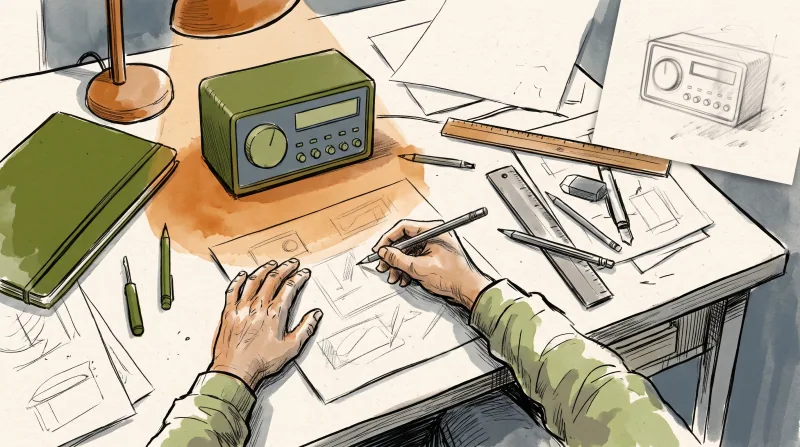
The Product designer focuses on evolving products through methods and processes from Industrial Design. Product designers work collaboratively with other professionals to develop artifacts that are sustainable from a business standpoint, technologically viable, and desirable to people.
The radio in the image below comes from a famous German company, Braun. With a minimalist design influenced by the Ulm School (considered the postwar Bauhaus), it became one of the companies that most influenced contemporary design.
Braun Radio SK-2, from 1955
There are millions of types of products that designers can develop, such as brooms, radios, aircraft, automobiles, computer programs, or processes, like improving people's experience in a hospital, which some call Service Design.
In this way the product designer has a generalist profile and follows the entire production chain of the artifacts. Although this term has been used for many years by designers of physical products, it has recently gained a lot of traction among designers of digital products.
An important book studied in design schools is PRODUCT DESIGN - Practical methods for the systematic development of new products. In it, the author presents universal methods for product development.
Product Design (M. R. Baxter, 1998)
The product designer in technology companies
In a scenario where the competition is one click away, technology companies that develop digital products try to consolidate or stay in the market by serving very demanding customers, and as a result the number of digital product designers has been growing quickly.
The need for a Product designer arises when it is essential that the product be easy to use, ergonomic, aesthetically pleasing, and in line with the market.
In this context the Product designer focuses on the user experience, seeking to deeply understand the existing problem and developing a project with methods and techniques to find solutions that are desirable to customers, viable to build, and sustainable for the business.
Main activities
The work of the Digital Product designer can follow several approaches, and its responsibilities can differ from company to company, but in general the processes are similar to those of the double diamond methodology, starting with the stages of investigating and defining the problem.
After these stages the Product Designer starts sketching ideas so that the proposed solutions become clearer. Next, the designer can test their hypotheses and evaluate how the customers' experience is going. Last comes the refinement stage, so that the product reaches the customer with an excellent finish.
The Product Designer's work is collaborative and, in the discovery stage, it must happen together with people whose role is to understand and make decisions about business and engineering. This professional needs to articulate design decisions with many other professionals and make sure everyone is aligned on the proposed solutions.
Articulation and politics are frequently part of the work, because design needs to meet various requirements such as business rules, technical and deadline limitations, usability risks, legal or marketing risks, and several others depending on the nature of the problem.
Being a product designer day to day means talking to many people, helping define solutions as a team, and orchestrating the process of conceiving the design. Otherwise the design may not solve the business problem, may be impossible to build within the established deadline, or may offer a terrible experience to the customer. Each area of a company has its own goals to reach, and the culture of user experience may not be well established, so the power of persuasion becomes urgent.
Area of focus
The Product designer's area of focus has become popular within the Squads of the technology field, but it can happen in many ways and scenarios.
The Product Designer's main activities are oriented to the tasks that users will have to perform in the product. Below, these stages can be seen highlighted in purple, based on the diagram of the Elements of User Experience (Garret, 2002).
Moments when the Product Designer acts
Many technology companies are currently adopting the continuous discovery and continuous delivery model. This basically means there is a moment when you research and learn and another when you build and improve, which is why they are called "Discovery" and "Delivery."
Behind the simplicity of what was said, it is necessary to stress that adopting this model effectively is not easy, because it requires the engineering, design, and product teams to be aligned, with an advanced technology structure and mature processes.
Discovery
At this moment the Product designer's role is to take part in Discovery together with the Product Manager, investigating the users' pains, needs, and problems and analyzing the business goals. This interaction is important so that the designer deeply understands the problem and can generate several solution hypotheses.
The designer should explore problems by investigating their causes with qualitative and quantitative research, creating flows and diagrams, using facilitation techniques to generate ideas, and aligning with the engineering team, suppliers, or other people involved.
Delivery
At this moment the Product designer's role is to work together with the Squad, which is made up of engineers and analysts. This happens by turning ideas into high-fidelity interfaces and documenting them so that engineers can build them and deliver them to the customer.
What do we conclude?
Although the term "Product design" is not new, and the general concept of the scope of work is old, we notice that the Design profession has evolved and spread deeply in the digital product market.
It is worth remembering that this professional has already been called Information Architect, Interaction Designer, User Experience Designer, UX/UI, and others. Eventually the responsibilities and area of focus may change with time and place.
The big novelty I notice is the designer's interaction with the Product Manager, who connects business, people, and technology so that the company builds things that people actually use. See more about Product Culture and Product Discovery.